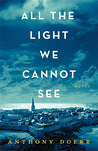
 All the Light We Cannot See by Anthony Doerr
My rating: 4 of 5 stars
Anthony DoerrAnthony Doerr was sitting next to a man talking on his cell phone, in a train heading towards New York. When the train approached the Penn Station, the signal dropped and the call disconnected much to the chagrin of the man who was talking. That made Doerr think about the things we cannot see - "the idea about all this electromagnetic radiation we can't see that's flying through walls and through buildings". (https://www.goodreads.com/interviews/...). Communicating through radio, and cell phones, bridging the huge distance that lay between the two ends was something that fascinated Doerr and he decided to write on the subject. He researched on radios and this research let him to the Nazi era. And the plot for the book All The Light We Cannot See[bookcover:All the Light We Cannot See|18143977] started taking shape.
When I started reading the book, it was a difficult and distracting read. Due to the complex language used, I found myself progressing slowly through the pages. And I would often want to opt for 'easier' works. But there was something that egged me on and I am happy to have finished the book. All in all, it has been a memorable read to me.
The story revolves around two characters - a blind girl Marie-Laure who is French and a young German boy, Werner Pfenning who is driven towards the magic of radio transmissions. There is the presence of that precious 'diamond', the Sea of Flames, which some believe carries a curse. The one who owns it will survive but bring disaster to those who are close to him/her. While he himself has never actually seen the stone, the warder of the museum says, "You have to believe the story." The stone looms large in the novel. Marie-Laure often speculates on the 'curse'. Things happen - events that change the course of her life in a way she had not imagined before. And just like Dr Geffard, the mollusk expert has told her, "You know how diamonds - how all crystals - grow, Laurette? By adding microscopic layers, a few thousand atoms every month, each atop the next. Millennia after millennia. That's how stories accumulate too. All the old stones accumulate stories. ...." Marie- Laure's story also accumulates layers, converging with that of Werner and then, drifting apart, only to merge again later towards the end.
Radio acts as a 'connect'. While it seeks to hunt down the enemy, it becomes way early in the novel, a means of hope. " Open your eyes, and see what you can with them before they close forever." It plays the music that fills the air around Werner with "possibility". It poses questions before curious minds - "So how, children, does the brain, which lives without a spark of light, build for us a world full of light?" Jutta, Werner's sister, is the voice of conscience that stays with Werner when he moves away from her. Jutta questions her brother about whether a thing that is being done by all "ought" to be done by them too. Her listening to radio broadcast makes her interrogate into the very idea of "purification" for which the Reich stands. She doubts "the staccato voice of the Reich" which "grows like some imperturbable tree". She does not belong to those who consider it as "the lips of God". She tells her brother that they are not "whole" - "We must be half something." What he refuses to hear from his sister, or perhaps hears but lacks the courage to believe in, he will hear from Marie-Laure through the radio. The radio, an instrument that is being used to capture, becomes a means of release.
Claire de lune by Debussy is a rendition of Paul Verlaine's poem with the same title. It is repeatedly referred to in the novel. The piece fits well with the larger theme of the book - a fight against the closed system of dictatorial rigidity. Werner's radio and Marie's adventures in reading are escapes within that closed system. The music of Claire de lune liberates. It lets the German Volkheimer listen not just to the notes but also "the silences between them" taking him to a place where his grandfather is. It gives Marie-Laure the courage to overcome her fear of General Von Rumpel. It brings back to Von Rumpel the memory of her daughter Veronika, who could sing. The world is being made a little human again, until the music lasts. Nothing is straight or simple in this world. As Marie-Laure contemplates:
"What mazes there are in this world. The branches of trees, the filigree of roots, the matrix of crystals, the streets her father re-created in his models. Mazes in the nodules on murex shells and in the textures of sycamore bark and inside the hollow bones of eagles. None more complicated than the human brain, Etienne would say, what may be the most complex object in existence; one wet kilogram within which spin universes."
The world of Nazi brutality, the "greatest project" of "ordering the evolution of the species", of "winnowing out the inferior, the unruly, the chaff" starts shattering. It is a closed world. It does not let the light in. But it degenerates from within. "The entropy of a closed system never decreases. Every process must by law decay." The decline happens from inside, giving way to a different kind of loss and a different kind of gain. Death stares in the face, but it brings with it "sublimity", "the instant when one thing is about to become something else. Day to night, caterpillar to butterfly. Fawn to doe. Experiment to result. Boy to man."
Another significant character in the novel is Frederick, Werner's friend at the military academy. He is according to Anthony Doerr, a version of himself and of one of his sons. (http://tweedsmag.org/interview-anthon...). They belong to that category of people who "pay attention to things others don't", which may be their strong point but is a "social weakness". Frederick is philosophical, a dreamer. He loves birds. And while Werner thinks that he is weak, Frederick knows that " Some people are weak in some ways, sir. Others in other ways." His distraction is his way out of the brutality of war. He imagines the world when it was "one endless garden from end to end" - all connected, without divides.
The model house that Marie-Laure carries with her is a dominant symbol in the novel. It is a powerful antidote to the Nazi system that is closed and impenetrable. Whether it holds the real diamond or not is something that is not disclosed till the latter half of the book. The inspiration for the house lay in a Japanese puzzle-box the author received as a gift when he was eight or nine years old.(http://tweedsmag.org/interview-anthon...) He was not told how the box opens. He was expected to figure it out on his own. The model house is also like a puzzle box. Whether it opens or not, whether it holds the 'real' thing or not, is something one needs to find out. It is the opposite of "certainty". It is the representation of "disorder" and "randomness". It is an expression of "imagination". It is a proof of "minds" working - minds, which are "not to be trusted" because they are always "drifting toward ambiguity".
All The Light We Cannot See is a brilliant work. It has been praised much for the its lyrical prose, and that is definitely justified. And despite my initial difficulty with the novel, I found it mesmerizing and beautiful and would strongly recommend it to all.
View all my reviews


